
Last updated October 30, 2026
 Home additions & ADU
 Kitchen remodeling
 Bathroom remodeling
 Roofing
 Windows & doors
 Driveway & pavers
 Fence
Free written scope consultation - allowances, timeline, and change-order rules on paper before a single trade is scheduled
General Contractor Maintenance Checklist for Moreno Valley Homeowners
The most expensive repair calls a Moreno Valley general contractor gets in October aren’t from years of neglect. They’re from three or four specific maintenance items homeowners didn’t know to check in April. A failed roof flashing after a Santa Ana wind event, a hairline foundation crack that widened through summer, an HVAC condenser choked with cottonwood and dust from five months of Inland Empire heat. Most of these cost under $200 to catch early. The reactive fix runs $4,000 to $12,000. This guide walks through what actually fails on Moreno Valley homes, when to look, and what you can handle yourself versus what needs a licensed contractor.
Styles & brands we work with
Quick Answer
A Moreno Valley maintenance checklist should be built around four seasonal walkthroughs: pre-Santa Ana roof and flashing checks in September, pre-heat HVAC and attic ventilation service in April, post-rain drainage and soil inspection in February, and a full exterior envelope check each fall. The items that save the most money are roof fastener and flashing inspections after any wind event above 45 mph, foundation reference-point monitoring on expansive clay soil, and condenser coil cleaning before the first 95°F week.
Table of Contents
- Roof Flashing and Fastener Checks: The Santa Ana Protocol
- Foundation and Slab Monitoring on Expansive Moreno Valley Soil
- HVAC and Attic Ventilation: April Through October, Not Just Summer
- Window and Door Alignment: Reading Soil Movement Early
- Drainage, Hardscape, and Flatwork After Winter Rains
- What California Law Says You Can and Cannot Do Yourself
- The Moreno Valley Seasonal Maintenance Rhythm
- Common Mistakes to Avoid
- When to Call a Professional
- Frequently Asked Questions
- The Bottom Line
Roof Flashing and Fastener Checks: The Santa Ana Protocol
Santa Ana winds are not a seasonal inconvenience in Moreno Valley. They are a structural loading event. When sustained winds push past 45 mph with gusts higher, every roof penetration on your home becomes a test point. Flashing around vents, chimneys, skylights, and the ridge line takes cyclic pressure that works nails loose over a single afternoon. We’ve walked roofs in Sunnymead Ranch after a two-day wind event and found flashing lifted a quarter inch off the deck, with the sealant underneath cracked and no longer bonded.
Most maintenance checklists tell you to inspect your roof once a year. That’s not enough here. The rule we give homeowners is simple: after any National Weather Service wind advisory above 45 mph, do a ground-level visual check with binoculars. Look for lifted shingle edges, visible gaps at flashing seams, and any shingle granules collecting in gutters or at downspout outlets. Granule loss after wind means the shingle’s protective layer is eroding, and that shingle is now aging at double speed.
What you’re looking for during a walk-up inspection, if you’re comfortable on a ladder:
- Flashing at every roof penetration: is the metal still flat against the penetration, or has it lifted at the corners? Lifted flashing lets wind-driven rain reach the underlayment, and Moreno Valley’s winter rains, while brief, are intense enough to do real damage.
- Exposed fasteners on ridge caps and hip shingles: rusted or backed-out nails are the first sign the roof’s wind resistance is compromised. One loose ridge shingle can unzip a section of the roof in the next Santa Ana event.
- Valley metal and step flashing: look for separation between flashing courses and the shingle above. A gap larger than an eighth of an inch is a leak waiting for the next rain.
- Attic-side check: on a bright day, go into the attic with the lights off and look for any pinhole of daylight through the decking. That pinhole is a water path.
If you find a problem, document it with photos and a date. If it’s beyond re-seating a single shingle with roofing cement, call a licensed contractor. Roof work in California requires a C-39 roofing classification, and even the most straightforward repair can void your shingle warranty if the manufacturer determines the fix wasn’t done to spec. We specify Moreno Valley Builders home roofing solutions from GAF, CertainTeed, and Owens Corning because those manufacturers have clear installation requirements, and we know exactly what their warranty auditors look for.
Foundation and Slab Monitoring on Expansive Moreno Valley Soil
Moreno Valley sits on soils that expand when wet and shrink when dry. The clay content across much of the city’s housing stock means your slab moves seasonally, even if you never see it. The movement is slow, measurable in millimeters per year in most cases, but it shows up first as hairline cracks in drywall corners, doors that stick only in certain seasons, and concrete flatwork that develops new cracks after winter rains.
The cheapest and most effective tool you can deploy is a set of reference points. Here’s how:
- Pick five to eight fixed points around your home’s exterior: foundation corners, slab edges at the garage door, porch steps, areas where concrete meets the stucco line.
- Mark each point with a small paint dot or a numbered tag. Photograph each point with a ruler for scale, dated.
- Re-photograph the same points every March and September. Compare the photos side by side.
- Measure any visible crack at three points along its length with a crack gauge or a simple metric ruler. Log the numbers.
This sounds obsessive. It takes twenty minutes twice a year. What it gives you is a baseline, a documented history of movement you can show to a structural engineer or a general contractor in Moreno Valley if movement accelerates. Without a baseline, you’re guessing whether that crack has been there for five years or appeared in the last six months. We can’t tell you how many times we’ve been called out for a “new” crack that the homeowner’s own photos showed had been stable for a decade.
Real red flags: a crack wider than a quarter inch, vertical displacement where one side of the crack is higher than the other, cracks that run diagonally through door frames from corner to corner, or any crack that changes measurably between checks. Those deserve a professional evaluation, not another season of watching.
HVAC and Attic Ventilation: April Through October, Not Just Summer
Attic temperatures in Moreno Valley routinely exceed 150°F between June and September. Your HVAC system fights that heat load every single day, and the fight starts in April. Waiting until the first 100°F day in July to think about your air conditioner is how you end up on a two-week waitlist while your house hits 88°F inside.
The maintenance window that matters for this climate is April through October. Not “summer.” Here’s the sequence we recommend:
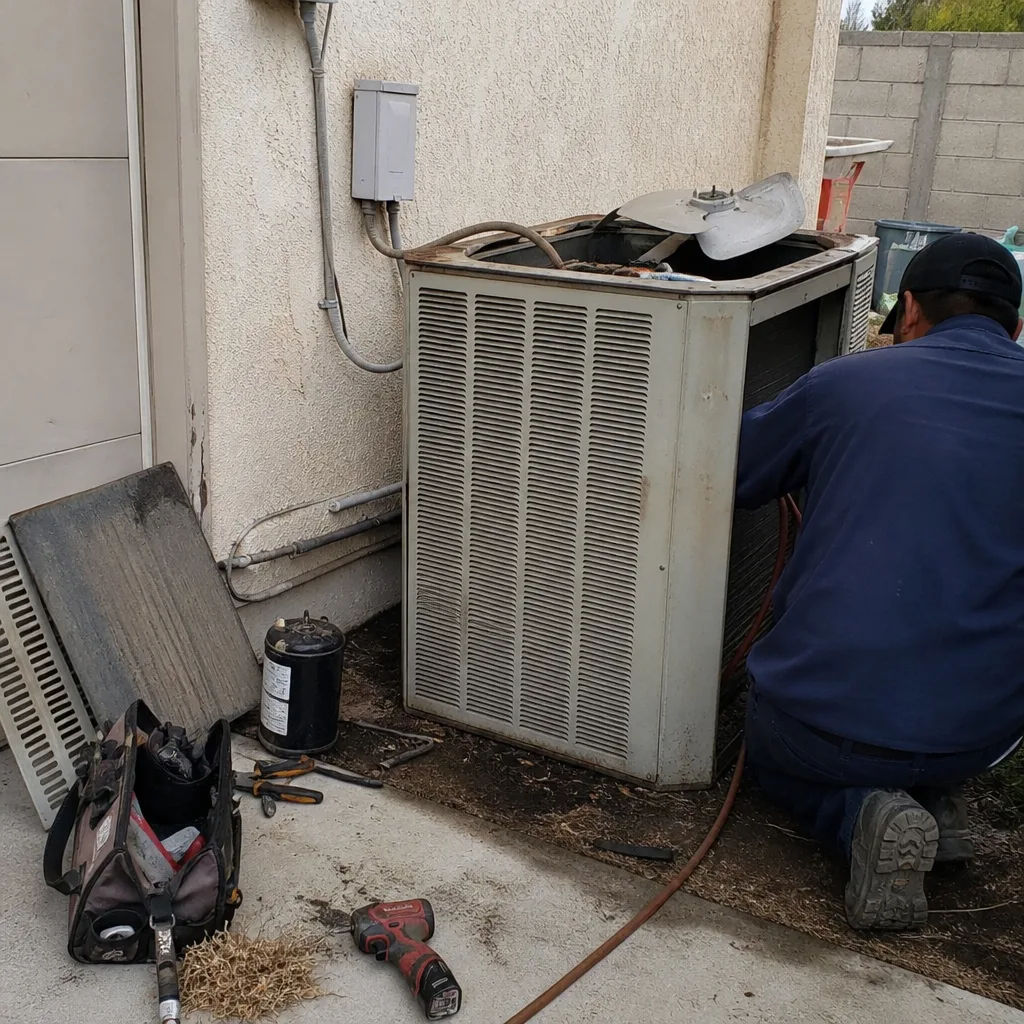
April: Replace or wash all return-air filters. Wash the outdoor condenser coil with a garden hose at low pressure, from the top down, until the water runs clear. Cottonwood season hits Moreno Valley hard in late spring, and a clogged condenser coil raises compressor head pressure, shortens compressor life, and adds real money to every cooling bill. Clear all vegetation back eighteen inches from the unit.
May: Check attic ventilation. Walk the attic at midday and compare the temperature to the outside air. If the attic is more than 20°F hotter than outside, your ventilation is underperforming. Look for blocked soffit vents, crushed flex ducts, bathroom fans venting into the attic instead of through the roof, and ridge vent blocked by debris or improperly installed baffles.
June through September: Monthly filter check. During peak cooling months, a dirty filter can add 5-15% to your cooling cost. Check the condensate drain line at the same time. A slow drip pan in the attic that goes unnoticed leads to ceiling stains, drywall damage, and mold.
October: Schedule professional HVAC service before winter. The best time to get a tech is when demand drops and before the first cold snap. A pre-season tune-up costs less than an emergency call in January, and the tech will catch a failing capacitor or worn contactor before it strands you without heat on a 38°F December night.
Window and Door Alignment: Reading Soil Movement Early
Your windows and doors are the most sensitive instruments you own for detecting foundation movement. They’re mounted in framed openings that flex with the structure, and small amounts of slab movement show up as changes in how they operate, before you’ll see it in a wall crack. The trick is paying attention to the right things.
Twice a year, in March and September, do this:
- Open and close every exterior door. Note any door that requires more force than it did six months prior, rubs at the top or latch side, or no longer latches without lifting the handle.
- Test every window that opens. Note any window that binds, sticks, or won’t lock because the sash no longer lines up with the frame.
- Stand back from each door and eyeball the gap between the door slab and the frame. It should be even top to bottom. A gap that’s visibly wider at the top than the bottom, or vice versa, means the frame has racked.
- Check for new gaps between interior door trim and walls, and between window trim and the drywall.
One sticky door is usually a hinge or a swollen slab from humidity. Two or three doors on the same side of the house, all binding the same direction, is a pattern. Patterns are what you’re looking for. A pattern of movement across multiple openings tells you the slab is shifting in a consistent direction, and that’s a conversation to have with a structural engineer or a licensed contractor before it becomes a bigger conversation.
When we do home remodeling in Moreno Valley, we always check door and window operation before we quote any work. It tells us what the structure is doing. A home with stable openings is a much more predictable project than one where every door binds differently.
Drainage, Hardscape, and Flatwork After Winter Rains
Moreno Valley’s rain comes in short, intense bursts. A single storm can drop an inch in an hour, and the soil, already hydrophobic from months of dry heat, doesn’t absorb it quickly. Water sheets off, finds the low points, and pools. The maintenance item most homeowners skip is checking where the water went after the first real storm of the season.
Walk your property during a heavy rain, or immediately after. You’re looking for:
- Water ponding against the foundation anywhere. Standing water within three feet of the slab for more than an hour after rain stops is a problem. It saturates the soil, and saturated expansive soil heaves.
- Downspouts discharging against the house. Every downspout should carry water at least five feet from the foundation, through an extension or a buried drain line.
- Water flowing toward the house across hardscape. Patios, walkways, and driveways that slope toward the foundation act as funnels. The fix is often re-sloping or adding a channel drain, not a bigger gutter.
- Erosion at the base of fence posts, retaining walls, or planter edges. Erosion now means settlement later.
Hardscape deserves its own check. Pavers from brands like Techo-Bloc or Cambridge Pavers are engineered to handle thermal cycling, but they sit on a base that can wash out if drainage fails. Look for low spots in paver patios after rain, pavers that rock underfoot, or sand joints that have washed out. Address base erosion while it’s a joint repair, not a full patio reset.
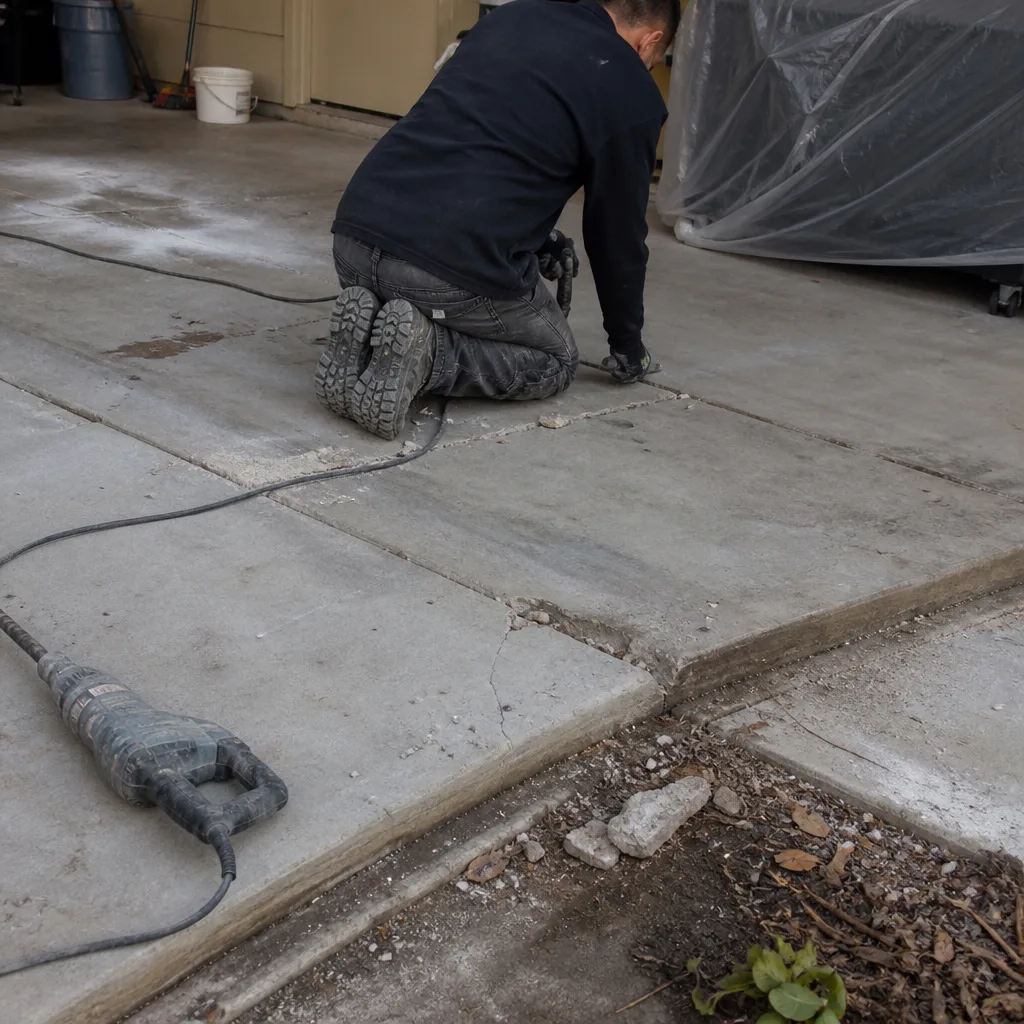
Concrete flatwork in Moreno Valley cracks for three reasons: soil movement, thermal expansion and contraction, and water intrusion that weakens the sub-base. Seal control joints every two to three years with a quality sealant. When joints are sealed, water stays out of the sub-base. When they’re open, water gets under the slab, erodes support, and turns a hairline crack into a lifted corner.
What California Law Says You Can and Cannot Do Yourself
California is clear about where the line sits. Homeowners can perform maintenance and minor repairs on their own property, but any work that requires a building permit, or that falls under the definition of contracting, requires a licensed contractor. The penalties for unlicensed contracting are serious, and the insurance implications of unpermitted work can follow you to resale.
Here’s the practical breakdown:
You can do yourself:
- Filter changes, condenser cleaning, and visual inspections
- Caulking, weatherstripping, and minor door hardware adjustments
- Gutter cleaning and downspout extension
- Painting, patching drywall, and cosmetic repairs
- Documenting cracks, taking measurements, and monitoring movement
- Concrete joint sealing and minor paver sand replenishment
Requires a licensed contractor:
- Any roof repair beyond a single shingle re-seat; roof work requires a C-39 classification
- Electrical work beyond replacing a light fixture; any new circuits, panel work, or rewiring requires a licensed electrician
- Plumbing beyond replacing a faucet or toilet; any pipe relocation, water heater work, or gas line work requires a licensed plumber
- HVAC work beyond filter changes; refrigerant handling requires EPA certification plus a contractor’s license
- Any structural repair, foundation work, or framing modification
- Any work requiring a building permit from the City of Moreno Valley
One more thing: performing work on your home that requires a permit, without pulling that permit, can make your home harder to sell. Buyers’ inspectors flag unpermitted work, lenders question it, and insurance companies decline coverage on it. The money you save doing it unpermitted gets spent, with interest, at closing. When we handle home renovation in Moreno Valley, permits are part of the process because they protect the homeowner, not because they’re red tape.
The Moreno Valley Seasonal Maintenance Rhythm
Here’s the whole checklist in one sequence. Print it. Tape it inside a cabinet door. It’s built for this city, not for a generic California climate.
January to February (wet season): Walk the property during rain and check drainage, downspouts, and ponding. Photograph any new cracks in flatwork. Check attic for leaks after each storm. Test all GFCI outlets.
March (post-rain, pre-heat): Re-photograph foundation reference points and compare to September. Test every window and door for binding. Check weatherstripping and replace where compressed or cracked. Inspect fence posts for rot at the base.
April (pre-heat): Replace HVAC filters. Wash condenser coil. Clear vegetation around the outdoor unit. Check attic ventilation and look for blocked soffit vents. Clean gutters and downspouts.
May (pre-peak heat): Second filter check. Test the irrigation system for leaks and adjust sprinkler heads away from the foundation. Inspect exterior paint and stucco for cracks, especially at the southeast and west exposures where thermal stress concentrates. Apply fresh caulk to window and door exteriors where old caulk is cracked or pulling away.
June to August (peak heat): Monthly filter checks. Monthly condensate drain check. Watch for new drywall cracks at drywall corners during the driest part of the year. If a crack appears, mark it with a pencil dot and date and watch it.
September (pre-Santa Ana): Do the full roof flashing and fastener check described above. Walk the property and look for anything loose: fence boards, gate hardware, shed doors, patio furniture that could become projectiles. Trim tree branches that hang over the roof. Re-photograph foundation reference points and compare to March.
October to December (Santa Ana season): After any wind advisory above 45 mph, do the post-wind visual check for lifted flashing, loose shingles, and granule accumulation. Check gutters for debris after wind events. Test smoke and CO detectors twice during this window. Schedule the professional HVAC pre-winter tune-up.
Common Mistakes to Avoid
- Waiting until July to service the AC. By July, every HVAC tech in the Inland Empire is booked out two weeks. April service costs less, happens on your schedule, and catches problems before the system runs at full load for months.
- Ignoring a sticky door because it’s “just the weather.” A door that binds in summer and loosens in winter is reporting soil movement. Write it down. Track it. The pattern matters more than any single observation.
- Using a pressure washer on the condenser coil. High-pressure water bends the fins flat and kills airflow. Low pressure, garden hose, top down. Thirty minutes of patience, no fin tool required.
- Caulking over cracked stucco without addressing the crack. Caulk seals water out, but a growing crack will push through the caulk in a season. Document the crack, watch it, and if it grows, get an evaluation before you spend money on a cosmetic fix.
- Checking the roof only from the curb. Ground-level checks miss flashing issues, lifted shingles, and ridge damage. Binoculars help, but a ladder-level inspection, even once a year, finds more.
- Running bathroom fans less than thirty minutes after a shower. In Moreno Valley’s dry climate, mold feels like someone else’s problem. It’s not. Trapped moisture in a bathroom with an exterior wall that bakes at 140°F creates the temperature differential that drives condensation inside the wall cavity. Run the fan.
- Postponing permit-required repairs until “sale time.” The defect gets worse while you wait, the repair gets more expensive, and you’ve spent years living in a house with a known issue. Fix it when you find it, and the resale takes care of itself.
When to Call a Professional
Some findings belong in a contractor’s lap. If a roof inspection reveals lifted flashing or missing shingles across multiple areas, if your foundation reference points show measurable movement in a single season, if water pools against the foundation after every rain, or if your HVAC system needs anything beyond filter changes and coil cleaning, that’s the moment to call. The cost of a professional evaluation is always less than the cost of the repair that evaluation prevents. Moreno Valley Builders offers free estimates in Moreno Valley. Call (877) 752-3154 and we’ll walk the property with you, tell you what we see, and tell you what actually needs action.
Frequently Asked Questions
Do a visual check after any wind event above 45 mph, plus a full ladder-level inspection every September before Santa Ana season peaks. That’s more than once a year because Moreno Valley’s wind cycle demands it. If you’re not comfortable on a ladder, call (877) 752-3154 and we’ll do the walk for you, free.
Hairline crack monitoring costs nothing but your time. Epoxy injection for a stable crack runs $500 to $1,500 depending on length and access. Actual foundation repair, if movement has accelerated and piers or underpinning are required, starts around $8,000 and goes up from there, and that’s exactly why reference-point documentation matters so much. Early detection keeps you in the monitoring phase instead of the repair phase. Call (877) 752-3154 for an evaluation and an honest recommendation, whether that means repair or just watching it.
Yes. Roof replacement requires a building permit from the City of Moreno Valley, and the contractor must hold a C-39 roofing classification. Unpermitted roof work creates resale problems and can void the shingle manufacturer’s warranty. When we handle roofing through a general contractor in Moreno Valley, the permit is standard procedure.
Santa Ana winds are sustained and directional, which is different from a short gust. Sustained wind builds uplift pressure under shingle edges, works nails loose through repeated flexing, and concentrates force on flashing transitions where different materials meet. The damage is cumulative, which means a roof that survived last year’s wind season may be more vulnerable this year because fasteners have been gradually loosening. That’s the argument for checking after every major wind event.
The clay-rich soil expands and contracts with moisture changes, and the movement transfers up through the slab into the wall framing. Drywall corners and door headers are the first places that movement shows. Most corner cracks are cosmetic, but a crack that widens seasonally or runs diagonally through a door frame deserves a professional look. Track it first, then decide.
Yes, and it’s one of the smartest things you can do before spending money on a remodel. A pre-remodel walkthrough finds structural issues, drainage problems, and deferred maintenance that would otherwise surface mid-project as change orders. We do this walkthrough as part of every home remodeling project in Moreno Valley, before quoting, so you know what you’re building on. It’s a free consultation, and it’s the difference between a clean remodel and a project with surprises. Call (877) 752-3154 to schedule.
The Bottom Line
Moreno Valley homes fail in predictable ways. The heat cooks roofs and HVAC systems. The Santa Ana winds test every fastener and flashing seam. The clay soil moves slabs and cracks drywall. None of this is mysterious, and all of it is manageable if you check the right things at the right times. The checklist in this guide is built for this city, from what we actually see walking homes here. Follow it, document what you find, and call a licensed contractor when something looks off. The $200 proactive fix is always cheaper than the $8,000 reactive one. Moreno Valley Builders is a licensed general contractor serving Moreno Valley. Call (877) 752-3154 to schedule a free maintenance walkthrough or to discuss any repair this checklist turns up.
Written by the team at Moreno Valley Builders, serving Moreno Valley since 2017.
See the difference
 Before
 After
 Before
 After
 Before
 After